A frameless shower enclosure is the single upgrade that changes a bathroom most for the money. It removes the visual barrier of a framed screen, makes a small bathroom read as one space instead of two, and eliminates the aluminium channels and rubber gaskets where mould and limescale collect.
It is also the glass product most likely to disappoint if it is specified badly. This guide covers the glass, the hardware, the measurement problem, and the one issue that decides whether a Kuwaiti shower enclosure still looks good in two years.
Framed, Semi-Frameless and Frameless
- Framed: Every glass edge sits in an aluminium channel. Cheapest, and the most work to keep clean — the channels trap water, soap residue and limescale, and the gaskets discolour over time.
- Semi-frameless: The perimeter is framed but the door hangs frameless. A middle ground on both cost and appearance.
- Frameless: No perimeter frame. Thick tempered glass supported by hinges, clamps and brackets alone. The cleanest look, the easiest to clean, and the most demanding on measurement and hardware quality.
Frameless costs more, and most of the extra is not the glass — it is the thicker panel, the hardware that has to carry it, and the precision the installation demands.
Choosing the Glass
Thickness
Frameless shower glass is 8mm or 10mm tempered. 8mm suits smaller openings, fixed return panels and lighter doors. 10mm is the standard for a full frameless door, particularly a wide one — the extra thickness resists the slight flex that causes a door to drop out of alignment over time. Below 8mm, a frameless door will feel flimsy no matter how good the hardware is.
The glass must be tempered. This is not a preference. A shower enclosure is a glass panel in a wet room surrounded by hard surfaces and a person with no footwear, and tempered glass is the specification that makes that acceptable.
Clear, low-iron, frosted or tinted
- Standard clear: The default. Note that standard float glass has a faint green tint visible at the edges and across large panels, which becomes noticeable against white tiling.
- Low-iron: Sometimes called ultra-clear or extra-clear. The iron content is reduced so the green cast disappears and the glass reads truly colourless. Worth the upgrade on a large enclosure or against pale marble and white tile.
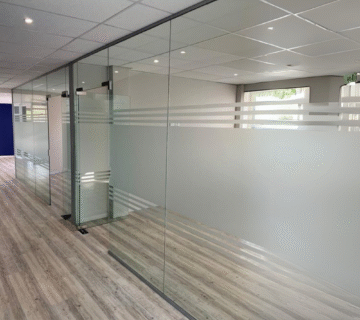
- Frosted: Sandblasted or acid-etched, full or banded. Gives privacy in a shared bathroom while still passing light.
- Tinted: Bronze, grey and smoked finishes have become popular in contemporary Kuwaiti bathrooms, particularly with black or brass hardware.
The Hard Water Problem — and the Coating That Solves It
This is the part most enclosures get wrong, and it is specific to the region. Kuwait’s water supply is largely desalinated and carries a high dissolved mineral content. Every time water dries on shower glass, it leaves those minerals behind. Within months an uncoated enclosure develops a cloudy white film that ordinary glass cleaner will not remove, and once limescale has etched into the surface it is permanent — the only remedies are professional polishing or replacement.
The answer is a protective hydrophobic coating applied to the glass, either at the factory or after installation. The coating fills the microscopic pores in the glass surface so water beads and runs off instead of spreading and drying in place. It does not make the enclosure self-cleaning, but it dramatically slows limescale build-up and makes a squeegee actually effective.
Specify the coating at the time of order. Applying it later to glass that is already etched does nothing — the damage is already in the surface. If a supplier does not mention water treatment when quoting a shower enclosure in Kuwait, that tells you something about the quote.
Hardware: Where Cheap Enclosures Fail First
With no frame, the hardware carries the entire weight of the panel through a few contact points, in a permanently humid environment. It is the wrong place to save money.
- Hinges: Heavy-duty wall-mount or glass-to-glass hinges rated for the panel weight. Look for adjustable hinges — walls are rarely plumb, and adjustment at installation is what keeps the door closing properly in year three.
- Material: 316-grade stainless steel, solid brass or properly finished alternatives. Lower-grade stainless and zinc alloy corrode in a hot, humid, chemically treated shower environment, and pitted hardware cannot be restored.
- Seals: Magnetic strips and drip seals keep water inside the enclosure. They are consumables and will need replacing eventually — confirm they are a standard size you can source again.
- Handles: Through-glass handles and knobs must be fitted to holes drilled before tempering. Decide handle position before the glass is made.
- Support bars: On wide openings and glass-to-glass joints, a support bar prevents long-term deflection. Ask whether one is needed rather than discovering later that it was.
Measurement: Why the Survey Decides Everything
Frameless enclosures have almost no tolerance. A framed screen hides a few millimetres of error inside its channel; a frameless panel has nowhere to hide one.
Bathroom walls are rarely plumb, tiled walls rarely finish square, and shower trays are rarely dead level. A competent survey measures at multiple heights, checks plumb and level in both directions, and designs the panel and hardware around what is actually there. Where the deviation is significant, the fix is either a wall profile that absorbs it or a panel cut to the wall’s actual line.
All of this has to be resolved before fabrication, because tempered glass cannot be trimmed, drilled or notched afterwards. Every hinge cut-out and handle hole is made before the glass enters the furnace. Measure once, wrongly, and the panel is scrap.
It also means the survey happens after tiling is complete, not from the architect’s drawing.
Frameless Shower Enclosures from Glass World
Glass World fabricates and installs frameless shower enclosures across Kuwait from our Al-Rai facility — 8mm and 10mm tempered glass in clear, low-iron, frosted and tinted finishes, with protective coating available, and hardware selected for the humidity of a Kuwaiti bathroom.
We survey after tiling, fabricate to the opening’s actual dimensions, and install with our own teams. Planning a bathroom renovation, or replacing a screen that has gone cloudy? Contact Glass World for a survey and quotation.
Frequently Asked Questions
What thickness of glass is used for a frameless shower enclosure?
8mm or 10mm tempered glass. 10mm is the standard for a full frameless door, especially a wide one, because the extra rigidity keeps the door aligned over time. 8mm suits smaller openings and fixed return panels.
Why does my shower glass look permanently cloudy?
Almost certainly limescale from Kuwait’s hard water. Minerals left behind as water dries etch into the glass surface, and at that point ordinary cleaners cannot remove it. Professional polishing or replacement are the only options, which is why a protective hydrophobic coating applied when the glass is new is worth specifying.
Can a frameless shower enclosure be fitted to walls that are not straight?
Yes, but it has to be designed for it. A proper survey measures plumb and level at several points and either specifies a wall profile that absorbs the deviation or cuts the panel to the wall’s actual line. This is decided before fabrication, because tempered glass cannot be adjusted afterwards.
Is frameless shower glass safe?
Yes. Frameless enclosures use tempered safety glass, which is substantially stronger than ordinary glass and breaks into small blunt granules rather than sharp shards. Correct thickness and properly rated hardware are what make the installation safe in practice.
What is low-iron shower glass and is it worth it?
Standard float glass has a faint green cast from its iron content, noticeable at the edges and across large panels. Low-iron glass removes that cast so the glass reads colourless. It is worth the upgrade on large enclosures and against white or pale marble tiling, where the green tint is most visible.
How long does a shower enclosure installation take?
Installation itself is usually completed in a few hours once the glass is on site. Fabrication after survey takes longer, since every cut-out and hole must be made before tempering. The survey must happen after tiling is finished, not before.